Travelling in the heat with your horse @horseandhound

horse trav in the heat tw 20716

9 tips for travelling in the heat with your horse

Travelling horses in hot weather

World Horse Welfare campaigns officer for research and education, Hannah Westen, gives her top tips for keeping horses hydrated when travelling by road.

1. Do your homework

If at all possible try to plan your travel around the weather conditions and avoid travelling during high temperatures and high humidity. If it is unavoidable pick the times of day when it’s likely to be coolest – setting off a bit earlier or later will make the experience much more pleasant for both you and your horse.

2. Plan ahead

Before setting off, it’s important to ensure horses are fully hydrated by providing them with unrestricted access to forage and water for at least six hours with plenty of space to rest and relax.

3. Prepare for the worst

Whilst it sounds pessimistic, when travelling by road you just never know when or for how long you might get held up, so make sure you have plenty of forage and water on board to keep your horses happy and healthy.

4. Provide good quality forage

Access to quality forage will not only maintain a healthy digestive system and provide an ongoing source of energy but also creates a small reservoir of fluid in the horse’s gut to help keep them hydrated.

5. Stick to frequent watering intervals

Horses should be offered water at least every four and a half hours whilst travelling, or more frequently in hot weather conditions.

6. Make water tempting

Anyone who has offered their horse a drink in an unfamiliar place will know that horses can be choosy about the type of container they will drink from and the taste of the water, but it’s important to stress that this doesn’t mean they’re not thirsty. If possible, try and take water from home and provide it in a bucket they are used to drinking from. In addition it’s always beneficial to familiarise them to different containers in case you can’t take your own. You can also try flavouring the water with apple juice.

7. Minimise stress

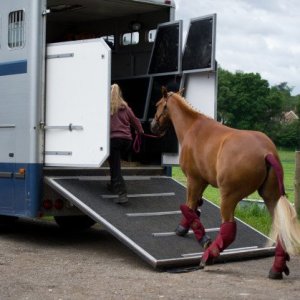
Horses can become dehydrated more quickly when they are stressed or unsettled so try to minimise this wherever possible. Loading and unloading are two of the main stressors for horses when travelling so make sure you do as much as you can to keep the process calm and relaxed. Practicing often without the pressure of heading to a show or event will help it become second nature and when you are on a schedule leave plenty of time to load. Ensure the vehicle is well ventilated and drive carefully to make the journey as comfortable as possible.

8. Prepare for the arrival

As with pre-planning before a journey, it’s just as important to give plentiful forage and water upon arrival at your destination. If you’re travelling to a show or event then make sure your horse has time to relax, eat and drink before competing or beginning exercise.

Like this? You might also enjoy reading these:

9. Know the signs of dehydration

Whilst a dehydrated horse can deteriorate quickly, dehydration can be very hard to spot so make sure you know what signs to look out for and can act fast if required. Indicators include depression, lethargy, dullness in eyes, decreased appetite, lack of or infrequent urination or defecation, licking surfaces, abnormal drinking behaviour such as drinking for extended periods of time, taking long draughts or gulping water.

Find out more at www.worldhorsewelfare.org

Rachael Blackmore and Minella Indo get round safe, finish 9th in the Grand National #GreatRelief

Horse & Hound   · Follow

nSdpresotol0c2990mf3u47agu1g8h01g0m5hhht90c651ai0042u5680510  · 

Rachael Blackmore, the first female jockey to win the Grand National, has written a children’s book about a granny who dreams of being a jockey, and her four friends who try to make it happen… read more via link below

‏Why horse poo could be the answer for engineers,@horseandhound


Pile fo horse poo in the field

It makes excellent compost and works wonders for roses, but engineers are the latest group to discover the power of horse poo — or more specifically, a well-ordered muck heap.

A study published in peer-reviewed journal Plos One has mooted manure as an alternative to hard-to-source top soil for land surrounding new roads and railways.

Titled “Is manure an alternative to topsoil in road embankment restoration?”, researchers concluded that your four-legged friend’s droppings are a viable option.

An estimated 1.5% of land in the European Union is covered by motorways and 5% by railways, which is expected to increase in coming years as population rises.

The land and embankments next to these, which are disturbed or created while the infrastructure is built, are often made up of nutrient-poor soil and lack vegetation.

While it is very important that plants grow on these to stop the banks — and ultimately the roads or railway — simply eroding away, top soil is scarce and expensive.
Read more at http://www.horseandhound.co.uk/news/manure-engineering-embankment-topsoil-617238#8froE1WFlUm7DvA8.99

Why horse poo could be the answer for engineers

Travelling in the heat with your horse..horseaware

horse trav in the heat tw 20716

9 tips for travelling in the heat with your horse

Travelling horses in hot weather

World Horse Welfare campaigns officer for research and education, Hannah Westen, gives her top tips for keeping horses hydrated when travelling by road.

1. Do your homework

If at all possible try to plan your travel around the weather conditions and avoid travelling during high temperatures and high humidity. If it is unavoidable pick the times of day when it’s likely to be coolest – setting off a bit earlier or later will make the experience much more pleasant for both you and your horse.

2. Plan ahead

Before setting off, it’s important to ensure horses are fully hydrated by providing them with unrestricted access to forage and water for at least six hours with plenty of space to rest and relax.

3. Prepare for the worst

Whilst it sounds pessimistic, when travelling by road you just never know when or for how long you might get held up, so make sure you have plenty of forage and water on board to keep your horses happy and healthy.

4. Provide good quality forage

Access to quality forage will not only maintain a healthy digestive system and provide an ongoing source of energy but also creates a small reservoir of fluid in the horse’s gut to help keep them hydrated.

5. Stick to frequent watering intervals

Horses should be offered water at least every four and a half hours whilst travelling, or more frequently in hot weather conditions.

6. Make water tempting

Anyone who has offered their horse a drink in an unfamiliar place will know that horses can be choosy about the type of container they will drink from and the taste of the water, but it’s important to stress that this doesn’t mean they’re not thirsty. If possible, try and take water from home and provide it in a bucket they are used to drinking from. In addition it’s always beneficial to familiarise them to different containers in case you can’t take your own. You can also try flavouring the water with apple juice.

7. Minimise stress

Horses can become dehydrated more quickly when they are stressed or unsettled so try to minimise this wherever possible. Loading and unloading are two of the main stressors for horses when travelling so make sure you do as much as you can to keep the process calm and relaxed. Practicing often without the pressure of heading to a show or event will help it become second nature and when you are on a schedule leave plenty of time to load. Ensure the vehicle is well ventilated and drive carefully to make the journey as comfortable as possible.

8. Prepare for the arrival

As with pre-planning before a journey, it’s just as important to give plentiful forage and water upon arrival at your destination. If you’re travelling to a show or event then make sure your horse has time to relax, eat and drink before competing or beginning exercise.

Like this? You might also enjoy reading these:

9. Know the signs of dehydration

Whilst a dehydrated horse can deteriorate quickly, dehydration can be very hard to spot so make sure you know what signs to look out for and can act fast if required. Indicators include depression, lethargy, dullness in eyes, decreased appetite, lack of or infrequent urination or defecation, licking surfaces, abnormal drinking behaviour such as drinking for extended periods of time, taking long draughts or gulping water.

Find out more at www.worldhorsewelfare.org